The importance of the image
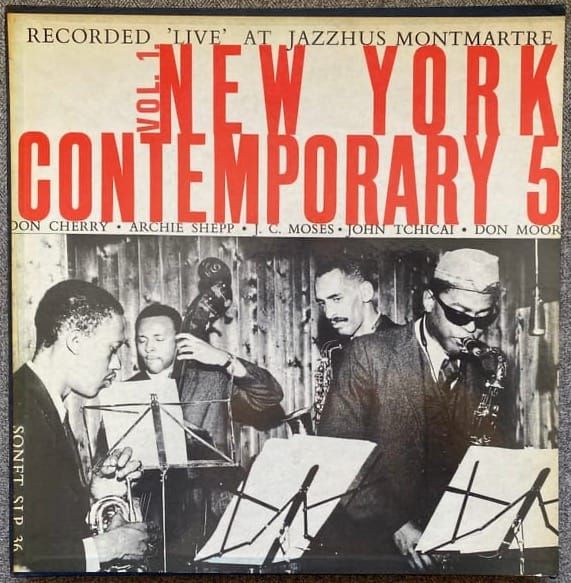
Don Cherry will forever be associated with his pocket trumpet. When he came to Denmark with the New York Contemporary Five in the autumn of 1963, some reviewers even wrote that he was performing on it, even though he was actually playing a cornet. And on the cover photo – taken at the Montmartre jazz club – for the two albums that the Sonet label released with the group, he is holding a pocket trumpet. Even though he didn't even brought it to Scandinavia. What happened?
Over the years I’ve been working on the Don Cherry biography, several odd and rather amusing stories have come to light. How the cover photograph for the two volumes New York Contemporary Five: Recorded “live” at Jazzhus Montmartre (Sonet) came about is just one of them.
The Sonet records were recorded on Friday 15 November 1963. By then, two and a half eventful months had passed since Cherry and the other members of the group – Archie Shepp, John Tchicai, Don Moore and JC Moses – arrived in Copenhagen and took over from Dexter Gordon at Jazzhus Montmartre. By then, they had managed two long stints at Montmartre, played at Don Pedro in Gothenburg and at Gyllene Cirkeln in Stockholm, they had recorded for radio and television in Denmark, for the TV program Trumpeten in Sweden, undertaken a short tour of Denmark, and were featured in Niels Holt’s short film Future One, which was filmed at Montmartre. Cherry had also made himself available to ‘local’ musicians, which he always loved to do, and learned a lot from. In Denmark this autumn, for example, he played several times with the Franz Beckerlee Quartet, which included the trumpeter Hugh Steinmetz, a group that would later change its name to The Contemporary Jazz Quartet/Quintet.
New York Contemporary Five were part of the avant-garde, yet they enjoyed a degree of popular success. It is therefore hardly surprising that the Danish record label Sonet wanted to round off their stay in Scandinavia with a record session. According to newspaper reports, the contract was signed just a week before the recording took place. There was some discussion about how it should be recorded: in the studio, in the studio with a guest ‘kødrand’ [‘meat line’ – difficult to translate], or live, as the music writer and radio presenter Torben Ulrich described it in the newspaper B.T. a few days after the recording: “They opted for the live format, and the jazz club was packed well into the evening with a lovely atmosphere. Erik Wiedemann was the label’s consultant and organiser, and Wiedemann says the group had great energy and was definitely above average – the NYCF average.”
New York Contemporary Five: Recorded “live” at Jazzhus Montmartre Vol. 1 was released in Denmark at the end of May/beginning of June 1964, with Vol. 2 following the next year. These are fantastic records featuring music that would later be described as “mainstream of the free jazz”, blending jazz tradition with the new trends prevailing in New York at the time. Sonet certainly made a significant cultural contribution; this was not the sort of music American record labels were interested in releasing at the time.
Except for the fact that the distribution situation was terrible, it would be several years before Polydor and Delmark released it in continental Europe and the USA, all seemed to be perfect regarding the releases. The music was great and the design was delicate and stylish, as was the group photo – probably taken by Jan Persson – even though JC Moses was missing. There was just one problem. In the original photo, Cherry was playing a cornet. It’s hard to believe that Cherry cared about it, but the record label may well have seen a selling point in showing Cherry with a characteristic pocket trumpet. What did they do? Well, they manipulated the photograph. It was Hugh Steinmetz who drew my attention to it, and if you look closely at the photograph, you can see how the image of Cherry has been pasted in. Hugh Steinmetz:
When they were going to make a picture for the record, because of his image of playing the small pocket trumpet, he asked me if he could borrow my pocket trumpet. Of course he could, and then they had a picture taken of him with that pocket trumpet, and then later they cut it into the other picture, you know. So it is not taken as one picture, it’s a collage.
So now you know!
(Thanks to Hugh Steinmetz)