Togetherness One on an 8-inch
In 1965, Don Cherry recorded Togetherness in Paris. Two sessions were held, and the album was released by the Italian label Durium the following year. With the help of a found 8-inch vinyl (!), I’ll attempt in this post to unravel some of the mystery that has always surrounded this album.
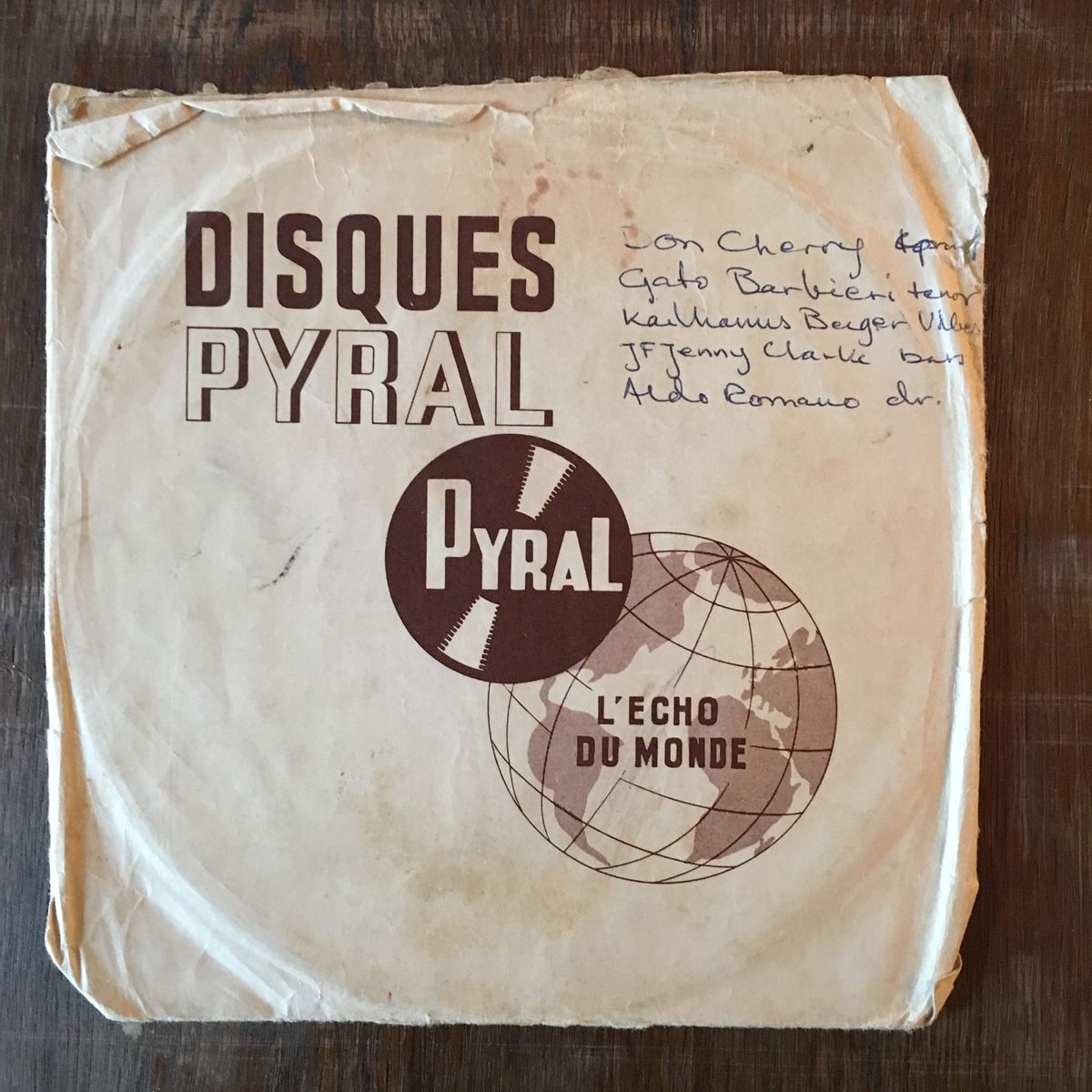
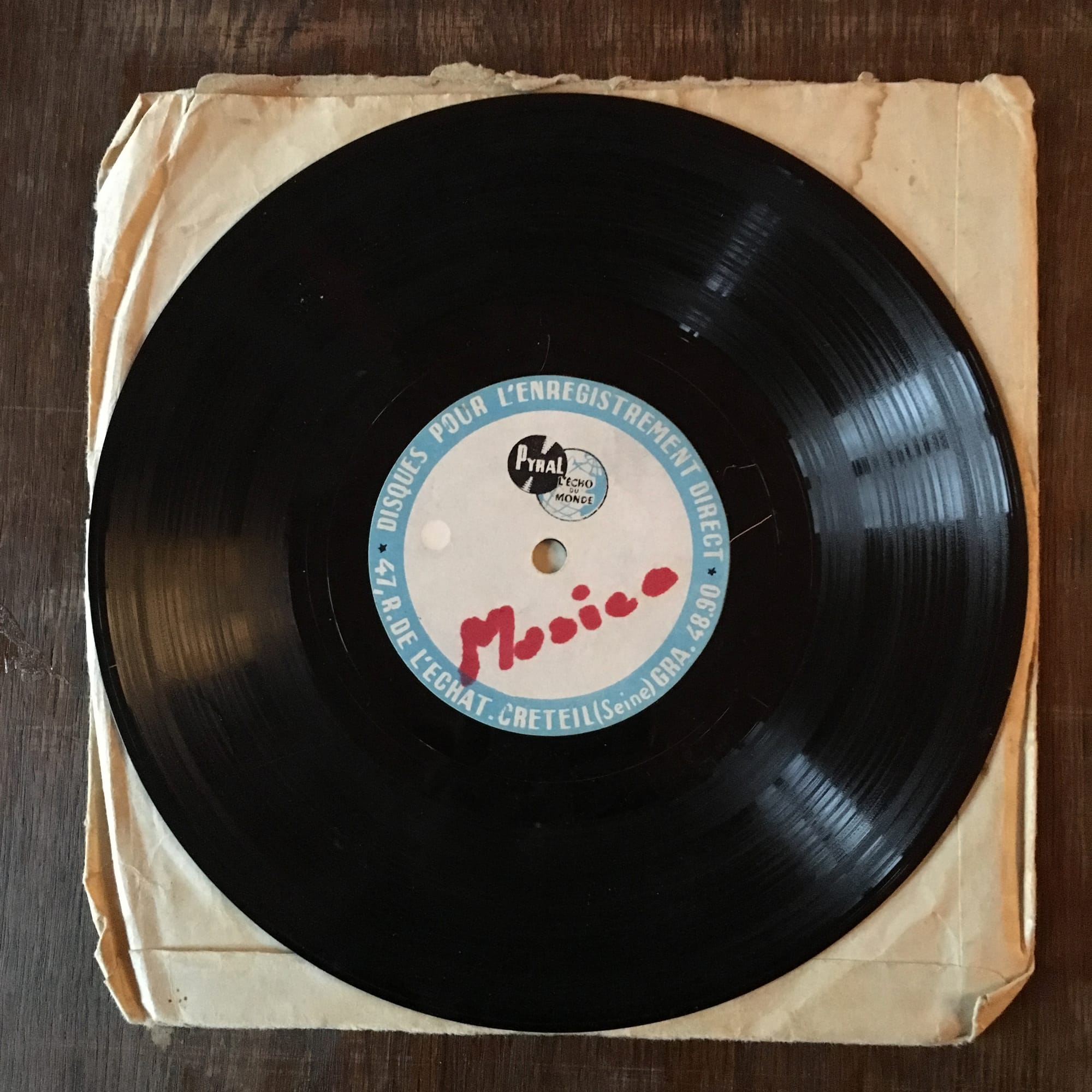
When in Tågarp a few years ago, Naima Karlsson (Neneh Cherry’s daughter) showed me a fantastic find they’d made. It was a vinyl record, the first and only 8-inch one I’d ever seen. It was a test pressing, or rather an acetate. The handwritten names of the musicians in the top right-hand corner of the cover allowed us to guess what it was: Don Cherry cornet, Gato Barbieri tenor, Karlhanns Berger vibra, JF Jenny Clarke bass and Aldo Romano drums. But it was only upon listening and comparing the grooves, that we realized it was one of the recordings for the album Togetherness. Or rather, the three tracks of Togetherness One, which make up the first side of the full-length album. Wow! Indeed, an incredible find from the vaults of Tågarp!
The cover was a pre-printed ‘inner sleeve’ from Disques Pyral (the French company that in 1934 invented the technology behind acetate or lacquer discs, which replaced the earlier wax and shellac discs). The logo consisted of the name Pyral written in a stylish, period-typical typeface on a printed graphic vinyl disc, along with the text L’echo du Monde on an accompanying globe. The label simply reads: ‘Disques pour l'enregistrement direct’ with an address in the French town of Créteil.
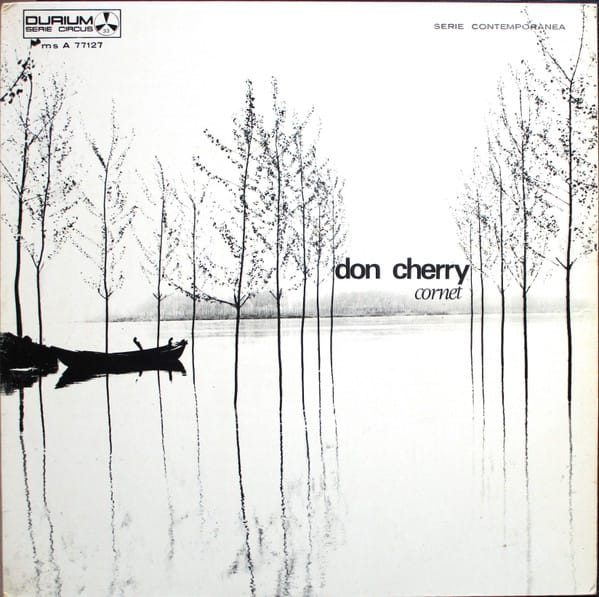
Togetherness has always been shrouded in a certain air of mystery. The liner notes of the original Durium release (Serie Circus ms A 77127) – written by the producer Mario Nikolao – states that it was recorded in the spring and summer of 1965. The location was Paris. No mention is made of where in Paris it was recorded, or by whom. And why was this French recording released in Italy? Part of the mystique can probably also be attributed to the fact that it was released in Europe; distribution channels were not particularly well-developed in the mid-1960s and much of jazz history was written in the US. When Blue Note released Complete Communion, featuring music from the same period but recorded at Rudy van Gelder’s studio in New Jersey, with partly different musicians, very few people were even aware of its predecessor, Togetherness.
When it comes to the place of the recording, drummer Aldo Romano was very clear when I interviewed him many years ago:
The French radio came down [to the club]. It was an afternoon session without an audience. Only the (guys] who were recording were there. Then Durium took the tapes and made the record. But it was not organized in that way in the beginning.
How Milan-based Durium got hold of the recording he doesn't know:
It’s possible that Michelle [Gato Barbieri’s wife at the time], who was quite a businesswoman, struck some sort of deal; it’s possible. But I never received any money or a contract from that. [Durium] was based in Milan, Italy, I don’t know much more than that.
The music on the found 8-inch, and what constitutes Togetherness One on the album, was thus recorded at Chat qui Pêche. Most likely on 22 April 1965. This was already established by the usually reliable Mike Hames and Roy Wilbraham in Don Cherry on disc and tape (a privately published mimeographed booklet from 1980). Still there has been some uncertainty to it. And even they were unsure whether it was a radio recording by the French broadcaster ORTF, as rumored. So the whole thing has been a bit confusing, and still is. For example it is not clear whether the recording was broadcast on French radio in 1965.
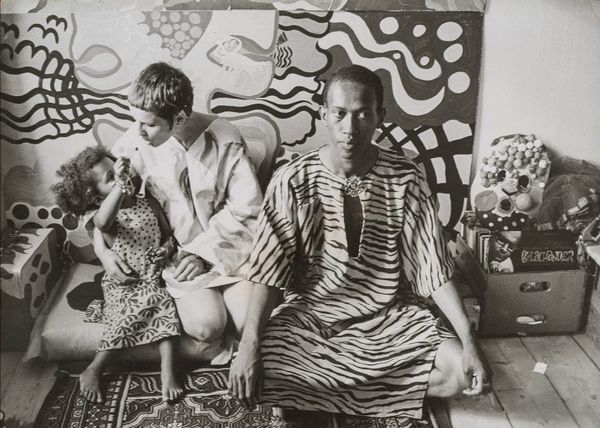
However, there was quite a lot of fuzz surrounding Don Cherry and the band at the time. Even so, when the recording was made, the band had only been together for a few weeks. But Chat qui Pêche quickly became their home venue. Karl Berger told me once:
We were playing at the Chat qui Pêche in Paris for six months, or eight months. It was actually our club, you know. When you walked in you would have like life sized images of the band. And if we played somewhere else we would always come back there. It was sort of our club.
In preparation for this newsletter, I was in contact with my French friend Pierre Crépon, a writer for publications including The Wire and We Jazz Magazine and an expert on free jazz from the 1960s onwards. He told me about another discovery, this time made by himself, and wrote the following (published here with his permission):
On the question of the recording location of Togetherness, I believe I have found the smoking gun. This was something I came across unexpectedly while doing research in the archives of national French radio, the former ORTF. In the mid-1960s, writer Lucien Malson hosted a show titled Connaître le jazz. The April 30, 1966 episode was dedicated to a discussion of the music of Don Cherry, who was presented as "free jazz’s third man," after Ornette Coleman and Eric Dolphy. The show’s guest was writer Michel Delorme, who described Cherry’s early 1966 appearances in Paris as revelations on par with the Charlie Parker revolution. During the latter half of the show, a tape of Cherry in France was played: unmistakably, it was the tape that would end up being used on Togetherness. Lucien Malson provided the following commentary (my translation):
"[Cherry] came to perform at the Chat qui pêche [club] last year [1965], we heard him in Paris. [ORTF producer] André Francis and our friends, the ORTF technicians, were on hand to capture this living music, echoes of which we can hear tonight."
The excellent sound quality of Togetherness certainly contributed to confusion about its recording location over the years: it sounds much better than the average club recording, but this is definitely consistent with the high technical standards of the ORTF. There was quite likely more music recorded at the Chat qui pêche… can it be found?
And there’s certainly more, and it's already found! Many years ago, I met up with Ben Young in New York. Among many other things, he gave me a recording featuring Cherry, dated 22 April 1965 at Chat qui Pêche in Paris. It's the same line-up as on Togetherness. You hear voices speaking, so it may be a live recording in front of an audience. The music is wild! Even wilder than on Togetherness! Crazy, unrestrained passages alternate with more subdued ones, and Barbieri’s playing is at times on a par with Albert Ayler. They perform a version of Ayler’s Ghosts, but also wind things down with a playful interpretation of Ornette Coleman’s Blues Connotation.
The sound quality isn’t as good on the record. But given that the levels are so even – for example, Jean-François Jenny Clarke’s bass is clearly audible – my guess is that this recording was also made by the French radio, ORTF. Maybe my copy has over the years been passed from cassette to cassette to cassette and has deteriorated as a result?
Continuing on the theme of Togetherness, the trumpeter Enrico Rava shared some interesting insights when I interviewed him. Before Gato Barbieri joined Don Cherry’s band in Paris in April 1965, he and Rava had been playing at a club in Rome for nine months. So they were close friends, and as I understand their wives were even related to one another. Rava spoke about Togetherness, which he initially thought had been recorded in Rome:
Maybe it was taped in Paris, and then they brought the tape to a guy called Mario Nicolao who produced the record. They mixed it in Rome maybe. But anyway, it was a very amateur kind of operation, it wasn’t like a real studio with real, you know, record engineers and shit. Also the mix and the editing was done very ... I remember Gato cutting with a scissor, you know cutting the tape and then putting it together with scotch tape, something like that. But the record for me sounds marvelous, for me it’s one of the best Don Cherry records. I like that more than Complete Communion, which is very nice. But it’s not that band, that band was amazing with Aldo, Karl and JF. They had a very very incredible interplay, and people loved them so much. It was very important in that moment, because the music was very, very free but at the same time it was very lyrical, very melodical. They had beautiful themes written by Don Cherry.
The album Togetherness will continue to fascinate. Above all, the explosive music of course, but also the mystery surrounding it. How Togetherness Two, the album’s second side, came about remains unknown. But it’s just as fine a recording as Togetherness One in terms of sound quality. I wouldn’t be surprised if French radio was involved in that too.
Did you enjoy this post? Why not become a paid-member to this newsletter? Or, if you’d like to support the project of writing a comprehensive biography of Don Cherry in another way, feel free to donate.
 Magnus Nygren