The Summer House Sessions

In this summer update, I’d like to go back 58 years in time. It was then – on 20 July 1968 – that Don Cherry recorded The Summer House Sessions in Kummelnäs, just outside of Stockholm. Together with a band that included both Swedish, European and American musicians they made a fantastic recording that was probably intended to be released as an album. But for some reason, it never happened. Until 2021.
For many years, the recording was circulating amongst collectors, but the sound quality wasn’t the best. To my great surprise, however – whilst researching Don Cherry – I found what appeared to be a final mixed version of the recording at the Centre for Swedish Folk Music and Jazz Research in Stockholm. A totally amazing find! A few years later – in 2021 – Brooklyn-based label Blank Forms released it as The Summer House Sessions. I wrote the liner notes for the album booklet with linguistic assistance from Andrew Lampert. Read it below.
I hope you all are having a great summertime. Here in Stockholm the weather is beautiful, sunny and warm. After this newsletter is posted, I will take a walk, meeting up with a friend and just enjoy summertime. All the best to all of you. /Magnus
- - - - - - - - -
In the mid-1960s, Don Cherry was spending much of his time living and working in Europe, after having established himself as an exciting and in-demand sideman to the likes of Ornette Coleman, Sonny Rollins, and Albert Ayler in the preceding decade. Active across the continent, particularly in Sweden where he would settle in 1970, Cherry transitioned from Sweden, coconspirator to band leader, forming several ensembles that all, in one sense or another, focused on group improvisation. His bands tended to be international in nature as well as membership, and their cross-cultural sounds were unique for the time.
Cherry called his technique "collage music" because the longform works he devised were built on an expansive and evolving array of melodies, harmonies, rhythms, and moods. Striking examples of this approach can be heard on the suites Complete Communion (Blue Note, 1966) and Symphony for Improvisers (Blue Note, 1967), two of his key records from this era, and among his earliest releases as a leader. While these albums are clearly jazz in terms of their musical themes and sensibilities, Cherry's fascination with world music and non-Western scales, present there, but latent, would bloom and come to dominate the projects that soon followed. He was always on the search for new creative material, not primarily for the avant-garde purpose of pushing boundaries, but as part of a larger mission to unite performers from different contexts in unexpected ways. He had a penchant for finding individual voices and inviting them into his collective musical orbit.
Always playing, and constantly moving between America and elsewhere, by 1968 Cherry was spending much of his time in Stockholm with his future wife Moki and her daughter Neneh (Eagle-Eye was born in 1968). Throughout 1967-68, Cherry was creating "symphonies for improvisers" that revolved around shifting musical partnerships and a growing catalog of musical material. He was making great strides with the development of his "collage music" method, however finding audiences to play for was a continuous challenge. Over the previous few years, Cherry's compositions had really begun to stretch beyond the parameters of postbop. His performances with the Complete Communion ensemble in Paris throughout 1965-66 had marked a major turning point in his development, as did the Happening-like Movement Incorporated project that he launched with Moki in Stockholm the following year. These fertile new directions led him further afield the identifiable world of jazz, which naturally led to problems getting booked at jazz clubs.
Despite the scarcity of paying gigs, Cherry stayed plenty busy in 1968 as an active member of two different working ensembles: the New York Total Music Company, a powerhouse of a band with an unfortunately brief existence, and a Swedish group that Cherry joined in 1967. The Total Music ensemble found him in the company of Steve Lacy on soprano saxophone, Karl Berger on vibraphone and piano, Jacques Thollot on drums, and Kent Carter on bass. Berger, who first played with Cherry in 1965 as part of the Complete Communion band, described this group as more of a "collective enterprise" than the earlier ensemble had been. Cherry's role as leader was less established here. "It was more free," Berger said, because the music rid itself of "tunes" and was no longer bound to a "tempo jazz concept." Their playing had a more open-ended quality thanks to Berger's vibes and the free rock dynamics of Thollot's drumming.
Cherry's Swedish group included musicians Bernt Rosengren and Tommy Koverhult on saxophones and flutes Leif Wennerström on drums, and Torbjörn Hultcrantz on bass. They were occasionally joined by trumpeter Maffy Falay, who sparked Cherry's serious interest in Turkish music when the two of them first met in 1965. The band was tightly knit, having gelled in the extraordinary workshops Cherry hosted at the ABF [Arbetarnas bildningsförbund) or Workers' Educational Association, in Stockholm, between February and April 1968. At weekly meetings in the ABF Hall, Cherry led participants in all sorts of musical research related to collective improvisation, playing in extended forms, breathing techniques, drones, Turkish rhythms, Indian scales, singing and chanting, silence, and "ghost sounds," among other pursuits. "Report to ABF," a newly discovered interview in which Cherry discusses these workshops at length with his friend and chronicler Keith Knox, can be found in Organic Music Societies, the sixth issue of the Blank Forms anthology.
Everything that Cherry tried to impart in those lessons can be heard on both his unpublished radio performances from this period, and here, on the previously unreleased "summer house sessions" from July 20, 1968. For these recordings, Cherry assembled an octet including members from both the American and Swedish bands. The Total Music Company (minus Lacy, who had already departed the group) had embarked on a two-month long German tour in April and performed at European festivals during the summer. A stay in Stockholm for a couple of days between gigs presented Cherry with an opportunity to blend them with his other group. Scandinavian players Rosengren, Koverhult, Wennerström, and Hultcrantz were joined by the French Thollot and the American Carter. Cherry also brought in Bülent Ates, a Turkish drummer who was living in Sweden for a short time. Berger was absent, for whatever reason.
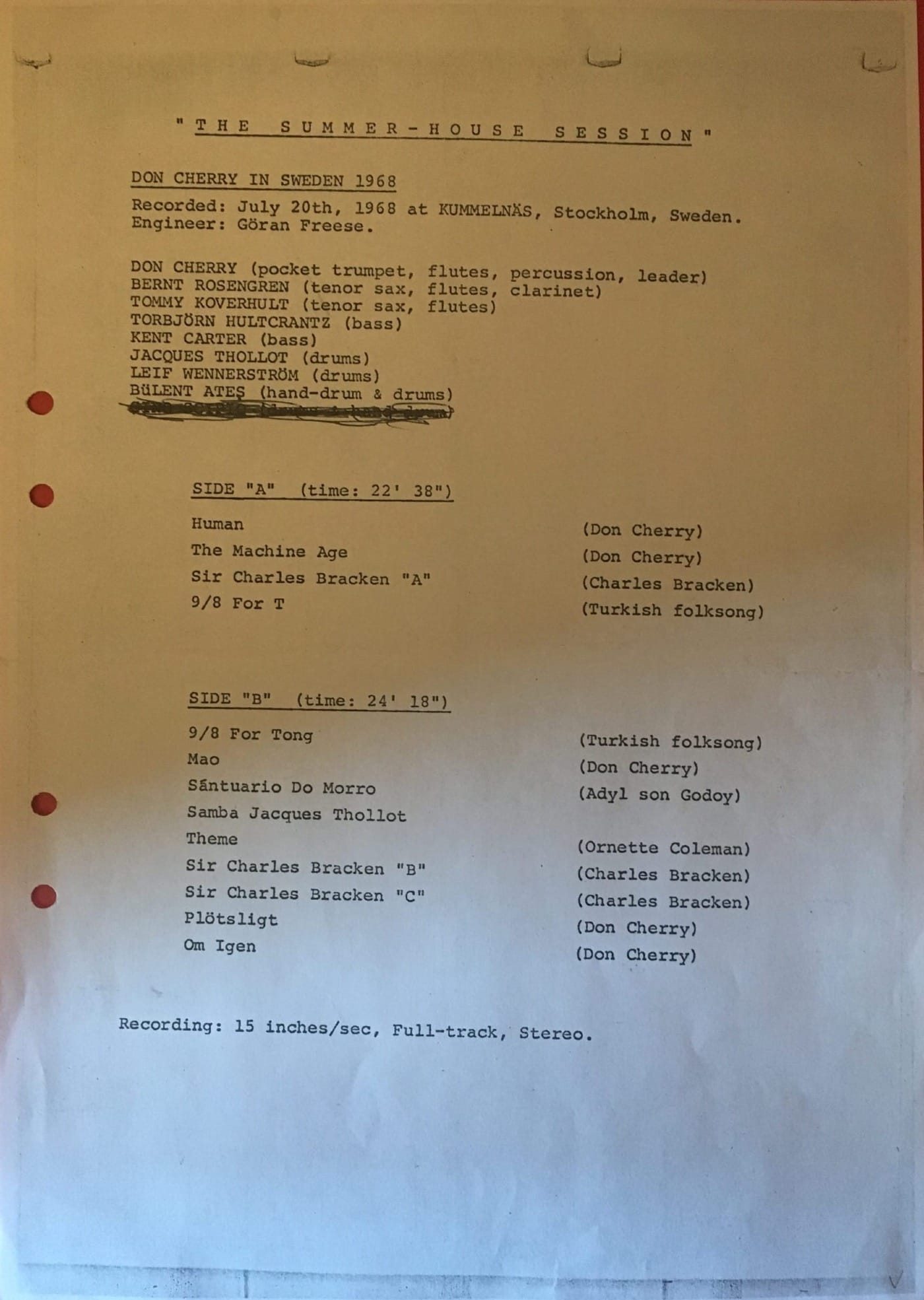
The twittering flutes that open the recording lead the ensemble headfirst into an assemblage that stitches together songs by Cherry, tunes by Coleman, Turkish melodies and rhythms, and the whirling themes of Sir Charles Brackeen by American tenor saxophonist Charles Brackeen, with whom Cherry had recorded as a sideman in January. The relationships among the players feel totally spontaneous, yet the flow between discrete sections appears completely structured. The group's tremendous energy, their relentless forward motion, makes it difficult to discern where each song starts and stops. The music is at times dense and propulsive without ever being particularly aggressive. The layers of percussion provide an incredible foundation from which the wind, brass, and string players blast off, yet no single musician ever dominates. Overall, it is a tuneful and surprisingly tight session where the diverse voices of individual performers rise, fall, and complement the others. The occasionally audible voices of children in the background add to Cherry's signature sound and provide a window into the welcoming, homey atmosphere he cultivated.
For many decades, the recordings gathered here were nothing more than a curio found in Cherry's sprawling sessionology. As it turns out, the master tapes were in the vaults of the Centre for Swedish Folk Music and Jazz Research, in the Göran Freese collection. A legendary sound engineer, Freese worked professionally in Stockholm's Decibel Studios from the late sixties onward. He recorded many of Sweden's more experimental albums from this era, including those by Sven-Åke Johansson, the Turkish-Swedish group Sevda, and a trio consisting of Johnny Dyani, Okay Temiz, and Mongezi Feza. He also privately documented many gigs by artists including Eje Thelin, Catherine Christer Hennix, and Bernt Rosengren in particular, using a portable Revox tape recorder. Working with Don Cherry, Freese captured a variety of concerts, rehearsals, and workshops, including the music found on records such as Organic Music Society (Caprice, 1973) and Eternal Now (Sonet, 1974). He also occasionally hosted recording sessions in his summer house in Kummelnäs, located on an island just outside of Stockholm. This album is a result of one of those outings. The original master had been mixed and was accompanied by printed information about the sessions, including a list of musicians and song titles, indicating that it may have been intended for release many years ago. This edition reproduces those attributed titles and credits.
Heard today for the first time, The Summer House Sessions is both a snapshot and a strongly formulated statement from Cherry as a composer, performer, and bandleader circa 1968. His group swings without being locked into time, plays off a pulse rather than a groove, and drifts between several national traditions. The spirit of jazz is certainly felt, but so too are the global folk melodies that Cherry came to emphasize in the coming years. Above all, it just cooks.
 Magnus Nygren
If you like this newsletter, feel free to support it even more. Either by a paid subscription or with a donation.